


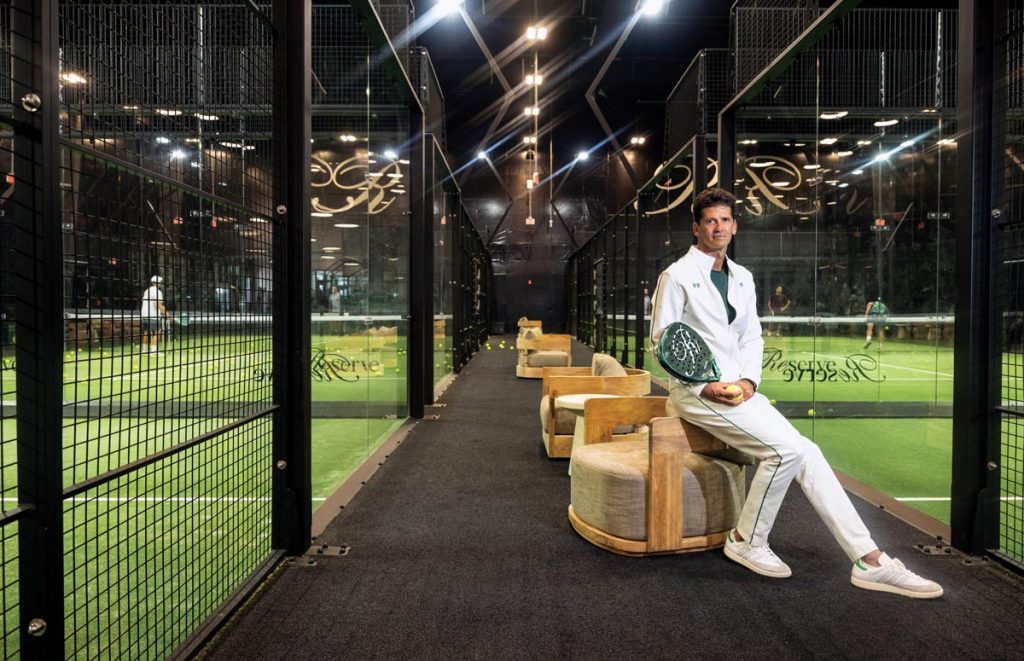
Businessman Wayne Boich is known around these parts for his savvy investments and his star-studded Art Basel bashes. But in recent years he has turned his passion for one of the nation’s fastest-growing sports—padel—into another successful business venture. With his Reserve Padel Club and his high-profile tournament, the Reserve Cup Series, Boich is methodically growing the game and its future, with no shortage of celebrities in the mix.
Yes, Inter Miami FC co-owner David Beckham, Formula 1 driver Max Verstappen, and former Miami Heat player Jimmy Butler have taken to the sport, but Boich says they weren’t the focus of his business. It was really about giving anyone from any walk of life the chance to do something fun and healthy with others.

“I have a real passion for this sport, because I know that it breeds community and health and wellness,” says Boich, a former top-ranked junior tennis player and U.S. Open Junior Competitor. “I thought if I could create a company and then have one wing of that company be focused on the build-out of nice clubs in the right locations, then we could have something special that could be a focus of folks’ days, where they think, ‘I want to fit in two hours at Reserve today and play a little bit of padel and hang out,’ whatever it may be.” Still, he admits the big names don’t hurt business. “Certainly, when you have celebrities who love it, it does push the needle a little bit.”

However, it didn’t take a celebrity to get Boich interested in padel when he first encountered it in 2013. There was just so much nuance to the game, he says. The courts were smaller and enclosed in glass. Instead of smashing the ball across the net, players could lob it off the glass to keep opponents on their toes.
The timing of the encounter was fortuitous. Boich was having a new home built and had originally planned to include a tennis court on the property. But the promise of padel was just too alluring for him to ignore. He scrapped his tennis court plans and opted for a padel court instead.

After Boich and his family moved into their new home, that court became the place to be. On any given day, Boich was there with the likes of former tennis great Andre Agassi, Beckham, or even Verstappen. When Butler came to the Miami Heat in 2019, he challenged Boich to a game, betting that he could beat him. Boich was not about to back down from the 6-foot-7-inch forward’s challenge.
“I said, ‘Okay, then I’ll see you at the house tomorrow,’” Boich recalls. “So, [Butler] showed up to the house and we were playing with some pros, and he said, ‘Maybe I’m not going to take that bet.’ He had played a couple of times, but not much. Through padel, we started a friendship.”
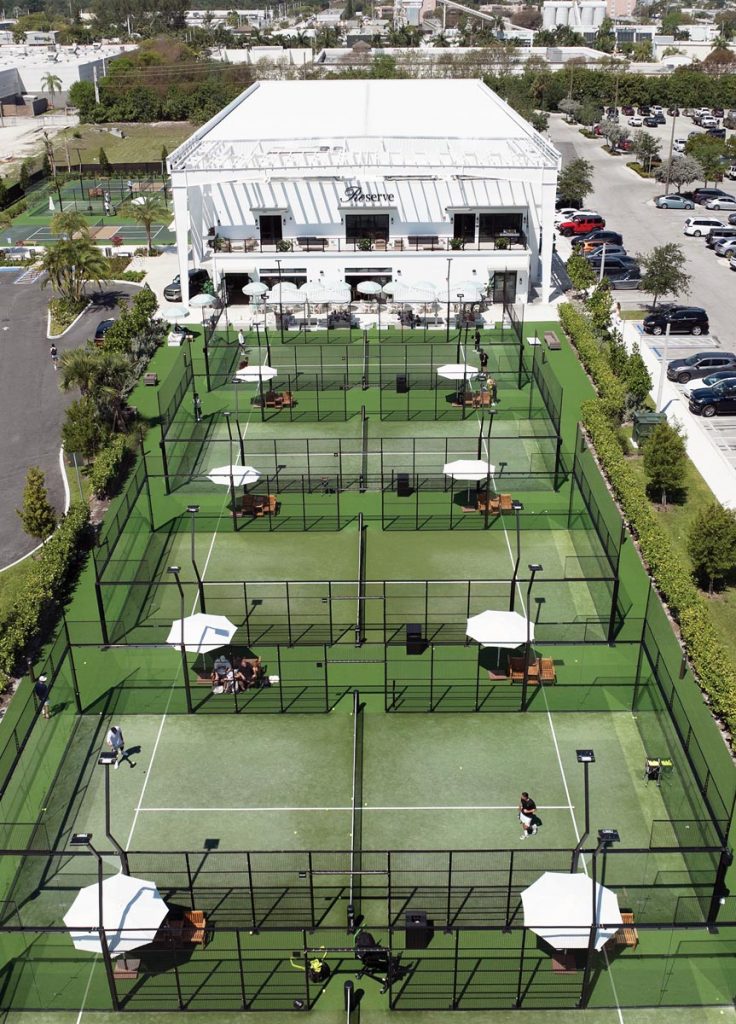
Soon, Boich began bringing professional players to Miami for exhibitions, and those games drew larger and larger crowds. When COVID hit in 2020 and padel clubs began springing up locally, Boich decided to turn his passion into a business. Never mind that he already had other businesses, three kids, and an always-packed schedule. His mind was made up. In late 2022, he launched Reserve Padel, a top-of-the-line membership club offering courts, coaching, and community.
“There were a lot of reasons not to do this if you’re me—ranging from the businesses I already have, to the time it was going to take, the travel it would require, and having a family at home,” Boich says. “But when you have an extreme passion for something and think you’re going to change the landscape of a sport, and you think of the position I’m in, the relationships I have, the passion I have for the game, I think I can make a meaningful difference in people’s lives. There’s so much more to this for me than looking at a spreadsheet and saying, ‘Oh, is this going to be worth x or y in three to five years?’”

The bet seems to be paying off. At press time, Reserve boasts three locations in Miami and another at Hudson Yards in New York City. Boich says a second New York City location is set to open in 2026. Two or three others may follow suit, but Boich won’t open a new club until he knows he can replicate to the letter what he has already begun. “We want to be able to do it right if we do it,” he adds.

Miami has been a great padel market, Boich notes, thanks to its diverse cultures.Good weather and fitness-minded locals have helped too. Kids are now flocking to the sport. Boich has certainly had a hand in this growth, not only in Miami, but elsewhere. This year, the Reserve Cup has evolved into a three-part, three-city series that includes athletes like Derek Jeter vying for victory.
Even more exciting, the local padel infrastructure Boich has built lured the world’s No. 1 padel player, Arturo Coello of Spain, to South Florida to train at Reserve Padel. Before Coello’s arrival, no top players had been training in the United States. Boich believes this could change the sport’s landscape and potentially make Miami the center of the pro padel universe. Until then, top athletes will continue to be among those playing at Reserve, talking big smack on tiny courts.
“It never ceases to amaze me how much blind confidence superstar athletes have in their skills, and how they believe those skills translate from a basketball court or soccer field to a padel court,” Boich says with a sly grin. “I appreciate the excitement, enthusiasm, and vigor with which they compete, so I never want to dissuade them from continuing to focus on their goal of being a champion padel player. Unfortunately for all of them, they will never become a champion padel player until they get proficient enough to be competitive. They all talk.”
On and off the court, you can be sure that Boich will continue to give them something to talk about.

Padel 101
Padel seems to have infiltrated the public consciousness. But what exactly is it and how does it differ from other racquet sports?
Padel began in Acapulco, Mexico, in 1969. When a wealthy businessman named Enrique Corcuera learned that he didn’t have enough space on his property for a tennis court, he built a smaller one instead. However, he found that it was too easy to overhit balls during a match. Tired of the daily ball roundup, Corcuera surrounded the court with walls and opted for wooden beach paddles instead of racquets, which are more forceful. His international set of friends fell in love with the sport and brought it back to their home countries.

Today, padel can be played in pairs (which is most common) or one-on-one. Players hit the ball over the net, just like they do in tennis. The casual observer will note that the game largely plays out like a game of tennis and is scored in the same way too. Because the court is enclosed, players can also hit the ball after it bounces off a wall to keep it in play, just like you do in squash. Instead of serving overhand at top speed, you serve underhand. Players are also able to leave the court to play a ball if the court has exit gates and as long as the ball doesn’t bounce a second time.

“The ability to really showcase touch and feel is important in the game, especially as you get better,” Boich says.
In padel, the courts are smaller, the balls are smaller, and the racquets (which have holes instead of strings) are too. While some players will wear tennis shoes, experts advise buying padel-specific shoes, which have more cushioning at the midsole. This will prevent strain to Achilles tendons, a common padel injury.
Much of the game vocabulary is the same as it is in tennis. However, two terms, Americano and Mexicano, are specific to the tournament format. The former involves switching partners and opponents every round so everyone plays against each other. The latter involves pairing opponents with the same number of points so matchups are equal.
“This is a sport where folks can get into it quickly and feel very athletic, very quickly,” Boich adds. “As you get older in life, the more you can feel athletic at anything you do, the more appealing it is and the more you’ll want to do it.”

The Rules of the Game
- Each point starts with a serve. The serve must always occur after a bounce and below the waist. The ball must cross to the opponent’s square, and players serve twice. The opponent can’t hit a volley when receiving a serve; the ball must bounce at least once first.
- After the bounce, the serve can touch the glass, but it cannot touch the side fence. Once the point begins, the ball can touch the fence.
- Any player in any area of the court can hit the ball. Like tennis, a player can only hit the ball once. Volleys are allowed as long as a player doesn’t invade the opponent’s side of the court.
- The ball can touch the sides of the court and the glass of the court. It can also bounce and leave the court and then re-enter (but only after a first bounce).
- The glass wall or other kind of wall can be used to return a ball—but not the fence.
- Players compete in six games to win a set, and a match comprises the best of three sets.
How to Score
- To score a point in padel, one of the following situations must occur:
- The opponent’s ball hits the net or another part of the court (wall, fence, spotlights, etc.) without the ball having previously bounced in the opponent’s court
- The ball bounces twice in the opponent’s side of the court
- The ball hits an opponent’s body directly
- The ball bounces in the opponent’s side of the court and goes out of bounds
- Accidentally or voluntarily, a player touches the ball more than once with the racket









Facebook Comments