



Before there were Super Bowls, Formula 1, multiple franchises, and international championships, Miami was a one-team town—the Miami Dolphins—defined by a fan base that bled aqua and orange. Fast-forward to 2026, and the landscape has shifted seismically.
Anchored by five major professional franchises—the Miami Heat, Miami Marlins, Florida Panthers, Miami Dolphins, and Inter Miami CF—the region has evolved into a thriving sports destination. In just the past six months, Miami has hosted a remarkable run of high-profile athletic events, including the College Football Playoff National Championship, Miami Marathon, Pegasus World Cup, World Baseball Classic, Miami Open, Formula 1 Miami Grand Prix, and Cadillac Championship. Now, with the FIFA World Cup arriving this month, Miami stands at the epicenter of the international sports economy.

Using sports as a promotional engine is nothing new. Since the city’s founding in 1896, Miami has positioned athletic events to draw visitors and entice prospective residents to relocate to the Magic City. In the early twentieth century, baseball, then firmly established as America’s pastime, played a central role in this effort. City leaders organized baseball tournaments at Royal Palm Park, adjacent to Henry Flagler’s opulent Royal Palm Hotel, offering tourists both entertainment and a compelling reason to relocate to a year-round paradise defined by beauty and temperate weather.
In 1920, Miami hosted the Cincinnati Reds for spring training at Tatum Park, later renamed Miami Field, located near the site where the Marlins’ ballpark would rise decades later. The Reds’ spring training stay in Miami was notable because the club from Cincinnati was coming off a World Series championship, and their first exhibition game was against the New York Yankees after their landmark acquisition of Babe Ruth.

Baseball’s influence on South Florida continued to grow in the decades that followed. The opening of Miami Stadium in 1949 established a long-standing hub for the sport, where a succession of minor league teams entertained residents and visitors for more than 50 years. Major League Baseball (MLB) arrived in 1991 with the awarding of the Florida Marlins, who began play in 1993 at Joe Robbie Stadium (now Hard Rock Stadium) before moving to Marlins Park (now LoanDepot Park) in 2012. The franchise captured World Series titles in 1997 and 2003, with the 1997 championship alone estimated to have generated approximately $155 million for the local economy.
In recent years, LoanDepot Park has hosted the World Baseball Classic, bringing together national teams from around the world. The tournament has drawn large international crowds to the stadium while also highlighting South Florida’s appeal as a global tourist destination. According to Fox Sports, the 2026 championship game was the most-watched World Baseball Classic broadcast to date, with nearly 11 million viewers worldwide.

During the real estate boom of the 1920s and the economic downturn that followed into the Great Depression, Miami emerged as a prominent venue for high-profile boxing events. On February 27, 1929, heavyweight contender Jack Sharkey defeated Young Stribling in a 10-round decision inside a temporary wooden arena constructed at Flamingo Park. After the fight, the arena’s stands were relocated to Allapattah, where they were repurposed into a more permanent facility known as Madison Square Garden Stadium, operated by the same organization behind its namesake in New York City.
South Florida remained a key stage for marquee boxing matches throughout the twentieth century. Most significantly, Muhammad Ali began training at the famed Fifth Street Gym on Miami Beach shortly after capturing a gold medal at the 1960 Summer Olympics. Ali went on to defeat Sonny Liston at the Miami Beach Convention Center on February 25, 1964, an outcome widely regarded as one of the greatest upsets in boxing history.

In the decades since, Miami has remained a favored destination for combat sports, as the spotlight has expanded beyond boxing to include hosting Ultimate Fighting Championship (UFC) bouts at the Kaseya Center.
Football was another means to boost tourism. In 1934 and 1935, Roddy Burdine, Earnie Seiler, and a group of local organizers launched a postseason college football game at Moore Park. Its early success led to the construction of a permanent stadium to host the event annually. Played each year on New Year’s Day, the game quickly became a cherished tradition and helped establish Miami as a premier destination for major college football matchups. The venue was initially named Roddy Burdine Stadium in honor of one of the event’s founders following his unexpected death in 1936, but it was later renamed the Orange Bowl, reflecting the game that defined it.

Over time, the Orange Bowl became the centerpiece of the college football postseason, showcasing national championship teams and marquee matchups. Locally, fans reveled in the dominance of the University of Miami from the 1980s through the early 2000s, a period highlighted by a remarkable 58-game home field winning streak at the Orange Bowl.
The Orange Bowl’s legacy extended beyond college football, serving as an early stage for the professional game as well. In 1946, the All-America Football Conference awarded Miami the Seahawks franchise, which played its lone season at the Orange Bowl and helped spark local interest in professional football.

That interest resurfaced two decades later when the city was awarded the Miami Dolphins as an American Football League (AFL) expansion team in 1965, with its first season commencing in 1966. Following the AFL’s merger with the National Football League (NFL) in 1970, the Dolphins joined the NFL and quickly rose to prominence under head coach Don Shula. During his early tenure, the team reached three consecutive Super Bowls from 1972 to 1974, highlighted by the undefeated 1972 season—still the only perfect season in NFL history—and back-to-back championships in 1973 and 1974. In all, Shula (who was inducted into the Pro Football Hall of Fame in 1997) guided the Dolphins to five Super Bowls.
Hosting major football events soon became ingrained in Miami’s identity. While the Orange Bowl game, the University of Miami, and the Dolphins have since relocated to Hard Rock Stadium, the early success of the Dolphins helped cement the city’s reputation as a major sports hub.

In the 1980s and ’90s, the arrival of new professional franchises accelerated. The region was awarded a National Basketball Association (NBA) team in 1988, the Miami Heat, followed by Major League Baseball’s Florida Marlins in 1991 and the National Hockey League’s Florida Panthers in 1992. Each franchise has since joined the Dolphins in reaching the pinnacle of its respective sport. The Heat captured NBA championships in 2006, 2012, and 2013, while the Marlins secured World Series titles in 1997 and 2003. More recently, the Panthers claimed back-to-back Stanley Cups in 2024 and 2025.
South Florida has long been a preferred host for football’s biggest events. The region has staged 11 Super Bowls, five at the historic Orange Bowl and six at the venue many locals still call Joe Robbie Stadium, now Hard Rock Stadium. Super Bowl LIV, held in Miami Gardens in February 2020 shortly before the COVID-19 shutdown, was estimated to generate $572 million in local economic impact. Events of this magnitude not only deliver an immediate financial boost but also serve as a global showcase for the region, producing lasting benefits for tourism in the years that follow.
Due to Miami’s international makeup, enthusiasm for fútbol—soccer to most Americans—has grown as well. That momentum reached new heights when Inter Miami CF signed global icon Lionel Messi, transforming the club into a worldwide attraction and helping to justify the development of a new $350 million stadium at Freedom Park.
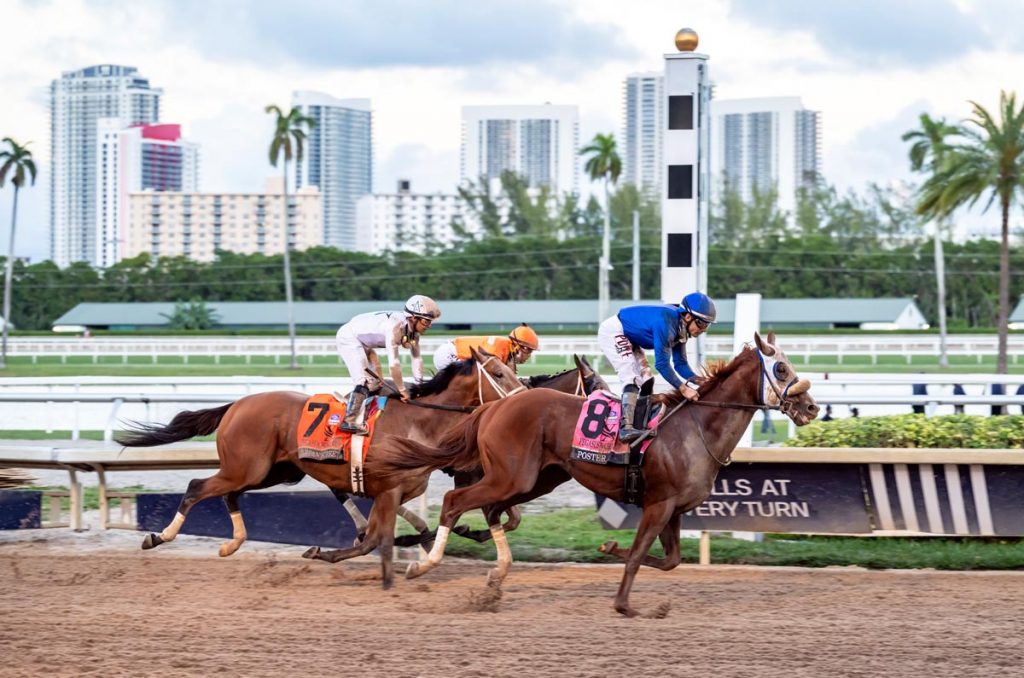
At the same time, a mix of established and emerging events, including the Formula 1 Miami Grand Prix, Miami Open tennis tournament, Pegasus World Cup, PGA Tour’s Cadillac Championship, and Miami Marathon, continue to draw visitors from around the globe.

Beyond headline-grabbing hype, these events deliver tangible economic benefits across the region, generating billions in impact. Major sporting events support thousands of jobs, from hospitality and transportation to event operations, while driving demand across hotels, restaurants, and nightlife. Long-term investment is equally significant, with large-scale developments like Inter Miami’s campus expected to generate an estimated 15,000 jobs.
In 2025, Miami-Dade County’s tourism industry welcomed more than 28 million visitors, generating roughly $22 billion in direct spending. While major sporting events represent only part of that total, South Florida’s rise as a sports mecca is fueling the region’s tourism economy, with momentum that builds year after year, cementing Miami’s status as a global sports powerhouse.
Casey Piket is a fourth-generation South Florida resident, Miami historian, podcaster, and creator of miami-history.com.









Facebook Comments